

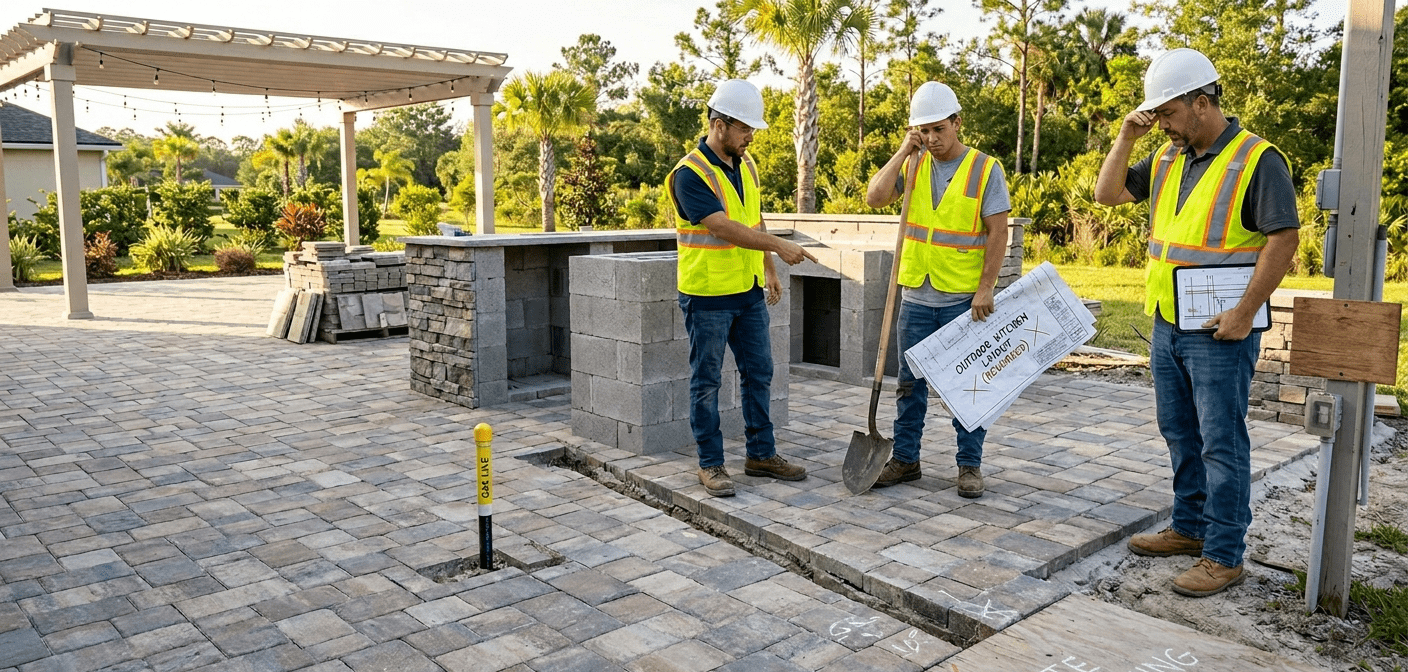
From time to time, there’s a moment on a jobsite when everyone pauses and realizes something was missed. It usually happens after the patio is in, the hardscape looks great, and someone says, “So… where’s the gas line going?”
That’s when an outdoor kitchen stops being a simple add-on and turns into a problem to solve.
What goes wrong when it’s planned too late
Outdoor kitchens aren’t something you can just add at the end of a project. They rely on coordination between gas, electrical, drainage, and layout before anything is poured or set. When that doesn’t happen, issues show up quickly.
Gas is often the first miss. It either wasn’t run at all or ended up in the wrong place, forcing crews to cut into finished concrete or reroute lines around completed work.
Electrical tends to follow the same pattern. Without early planning, there’s no power where it’s actually needed, which means trenching through a finished patio to make the space usable.
Drainage and layout are quieter problems, but just as important. Water doesn’t move the way it should. Grills end up too far from prep space. There isn’t enough counter space nearby, and the kitchen doesn’t function the way the homeowner expected.
These aren’t design issues. They’re sequencing issues.
What we see on jobsites
This is where things move from inconvenience to rework.
At CSS Fireplaces & Outdoor Living, we’ve had builders reach out after the slab was already poured, trying to figure out how to add an outdoor kitchen without undoing what’s already been built. In other cases, everything is in place, but the layout doesn’t support how the space will actually be used, so parts of the kitchen have to be adjusted or rebuilt.
Sometimes it’s not one big problem, just a few small things adding up. Utilities are a bit off, spacing is tighter than expected, or access wasn’t fully considered. It may not seem like much at first, but it all adds up and slows the job down.
These issues can be common, but they are also avoidable.
What changes when outdoor kitchens are planned early
When outdoor kitchens are planned before construction begins, the entire process runs more smoothly. Utilities are installed where they need to be. The installation stays clean with no cutting, patching, or delays. Layouts are built around how the space will actually be used, whether that’s a simple 5-foot setup or a larger 14-foot kitchen designed for entertaining.
It also helps keep costs predictable. Avoiding rework is one of the easiest ways to stay on budget. Just as important, the finished space feels intentional. It looks and functions as if it were always part of the plan.
What builders should do instead
The shift is simple. Treat the outdoor kitchen like part of the home, not an afterthought.
Bring the right team in during the design phase. Coordinate gas, electrical, and layout before the slab or pavers go in. Think through how the space will actually be used, not just how it will look on paper. It doesn’t take more effort. It just takes earlier decisions.
If you’re building in Northeast Florida, bringing CSS Fireplaces & Outdoor Living in early helps keep things on track. It saves time, reduces rework, and ensures everything is planned to fit the space from the start. Because we’re involved in both planning and installation, we understand how these spaces come together in the field. That leads to better coordination and fewer surprises once construction is underway.
If you’re planning an upcoming project, contact CSS Fireplaces & Outdoor Living to get your outdoor kitchen set up the right way from day one.